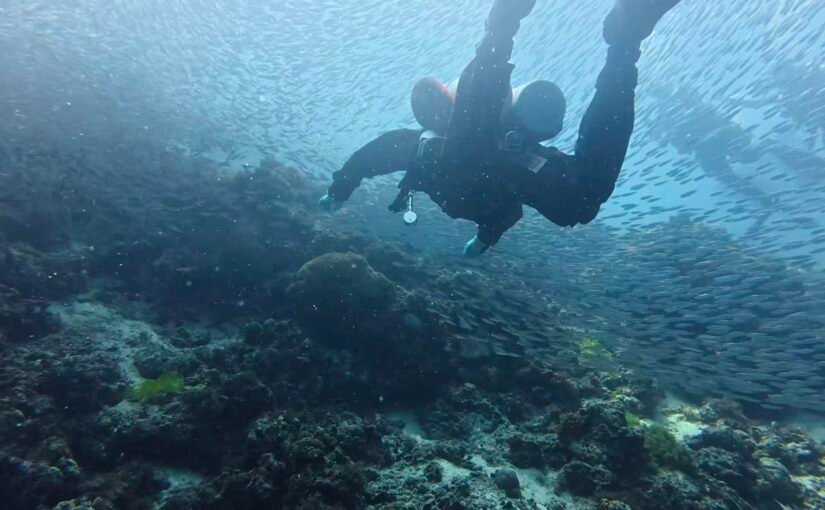
Quick Answer: A safety stop is a short pause at a shallow depth before surfacing during recreational diving, allowing your body to off-gas nitrogen in a controlled environment. Data from DAN suggests this significantly reduces venous gas bubbles in your bloodstream.
While the safety stop is crucial, controlling your overall ascent rate is even more important for giving your body time to off-gas nitrogen.
Recreational agencies like PADI and SSI typically require a maximum ascent rate of 18 meters (60 feet) per minute, but in practice, instructors usually ask you to keep it at 9 meters (30 feet) per minute, followed by a 3-minute stop at 5 meters.
However, technical diving practices demand even stricter ascent rates to achieve the same effect. For example, GUE divers ascend at 3 meters (10 feet) per minute during the final phase—and in the last 3 meters to the surface, they slow down to an incredibly gentle 1 meter per minute. This places a much higher demand on a diver’s buoyancy control and body positioning.
The Safety Stop is a Checkpoint, Not the Finish Line
Please remember: a safety stop is just a node in your ascent, not the destination. After the safety stop ends, you must continue to ascend smoothly and steadily to the surface.
I have seen inexperienced recreational divers finish their safety stop perfectly, only to bolt straight up in the last few meters. This causes the pressure inside their body’s air spaces to change far too rapidly. If the expanding gas cannot vent properly, it can easily rupture delicate capillaries, resulting in a sudden nosebleed. The final 5 meters back to the surface demand the same strict control over your ascent rate.
Think of your body during ascent like a shaken bottle of soda. At depth, pressure keeps the nitrogen safely dissolved. During ascent, the pressure decreases. If you rip the cap off too quickly by shooting to the surface, the soda explodes. But if you let it sit and open the cap slowly, there is no mess. Safety stops and ascent rate controls are designed for exactly this reason.
A safety stop is highly recommended in recreational diving to increase your safety margin. However, based on the physics of decompression, it is not strictly mandatory.
Safety Stop vs. Decompression Stop: Don’t Mix Them Up
Many beginners get confused here. The two are not the same:
🟢 Safety Stop (Recommended): A 3-minute pause at 5 meters. It is a best practice highly recommended for any dive deeper than 10 meters to increase your safety margin. However, based on decompression principles, it is not strictly mandatory.
🔴 Decompression Stop (Mandatory): A mandatory stop triggered when your bottom time and depth exceed the No-Decompression Limit (NDL). You must stop to let your body decompress, often for much longer than 3 minutes. Skipping a decompression stop results in an unacceptably high risk of Decompression Sickness (DCS).
The Real Challenge: Buoyancy Control
During ascent, as pressure decreases, the air inside your BCD expands proportionally. The area with the greatest proportional pressure change is the final 10 meters to the surface. When you reach the safety stop depth during ascent, the air in your BCD expands rapidly. If you cannot react quickly and effectively, you will easily float uncontrollably to the surface.
Practical Tip: Keep an eye on your depth changes on your dive computer. Vent the excess air from your BCD in small, frequent bursts. (Remember: buoyancy changes are not instantaneous; it takes a few seconds to reflect on your computer). Maintain a steady breathing rhythm. If you accidentally vent too much air, add air to your BCD in small, frequent bursts as well.
Real-world scenario (Local Dive Spotlight): PG Canyon
If you are diving at PG Canyon (Puerto Galera, Philippines), your safety stop will likely be a “blue water” drift stop. This site is famous for its dramatic underwater canyons, strong currents, and occasional downcurrents. Because there is usually no anchor line to hold onto, you must maintain neutral buoyancy while floating in the open blue. Stay close to your guide and the group, monitor your depth closely, and if the current starts pushing you during your 3-minute stop, avoid getting too close to the wall, control your breathing, and ascend as a team.
FAQ: What Should I Do If I Missed My Safety Stop While Diving?
If you miss your safety stop due to an emergency or strong current, do not panic. Do not go back down into the water to complete it.
Once you are safely back on the surface or the boat, the best thing to do is to breathe 100% oxygen. If pure oxygen is not available, breathing a rich Nitrox mix can also help. This helps your body flush out the residual nitrogen that you would have off-gassed during the stop.
Please remember: a safety stop in diving during a no-decompression dive is not a mandatory decompression stop. It is a recommended best practice to increase your safety margin, not a hard physical limit. As long as you followed a safe ascent rate and stayed within your NDL, missing the safety stop is completely safe. Please do not cause yourself unnecessary panic over a missed safety stop. You will be fine.
The Final Verdict
A safety stop is not a magic shield. It reduces risk, but it cannot rescue a reckless dive plan. However, it is a crucial habit that forces you to slow down, manage your buoyancy, and protect yourself.
Next time you are at 5 meters, enjoy those 3 minutes: look at the fish, check your pressure gauge, and ascend like a pro.
If you are a beginner looking to enter the diving world and want to understand the real risks, you can read this guide: Is Scuba Diving Dangerous?