Diving Safety Tips: From the Surface to the Boat (What Your OW Course Didn’t Teach You)

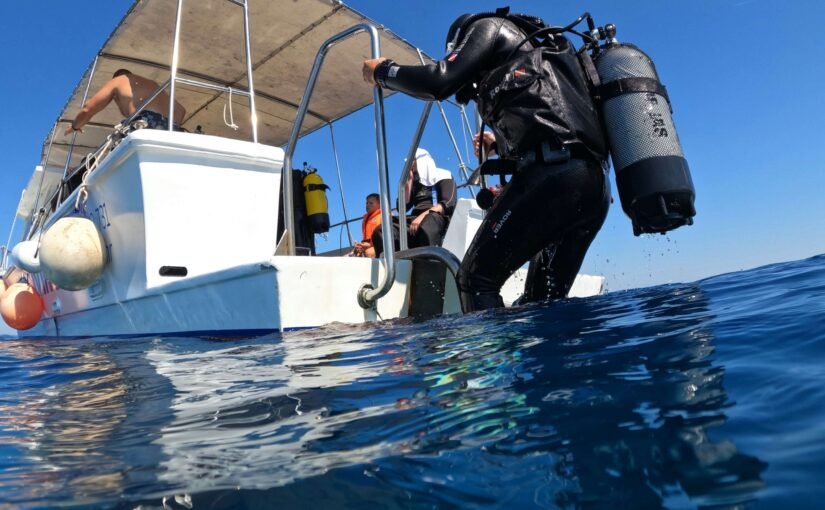
Most Open Water courses focus on what happens underwater. But the transition from the surface back to the boat is one of the most chaotic and injury‑prone moments of the dive. Here are 8 practical diving safety tips for your return to the boat that you won’t find in the standard training manual.

8 Practical Boat‑Return Safety Tips

1. Hold onto an Inflated DSMB

If the surface is choppy, inflate your Delayed Surface Marker Buoy (DSMB) and hold onto it. It provides extra positive buoyancy and keeps the waves from splashing you in the face.

2. Never Put Your Mask on Your Forehead

The ocean loves masks that are pushed up to the forehead. One wave is all it takes to sweep it away forever. (I have recovered countless masks from the seabed). If you must take it off your eyes, let it hang around your neck. Better yet, just keep it on your face until you are safely on the boat.

3. Keep a Safe Distance from the Ladder

Don’t crowd the boat ladder. Hold onto the safety line and keep a safe distance from the diver currently climbing. Always protect your head with your hands in case of sudden boat movement.

4. Take Your Fins Off ON the Ladder

Some divers take their fins off in the water to swim to the ladder. This is a huge mistake. Without fins, you have zero propulsion. In a current, you will be swept past the stern and won’t be able to swim back. Wait until you are physically holding the ladder to remove your fins.

5. Look for the Surface Line

Dive boats usually trail a floating safety line downstream from the ladder. Even careful divers get pushed away by currents. Grab this line to pull yourself back to the ladder safely.

6. Do NOT Hand Up Your BCD First

Pay attention to the order of removing your gear. Never hand your BCD and tank up to the crew first. Once you do, you lose control of your buoyancy. If the current pushes you away, you have no positive flotation. Hand up your weight belt first, but keep your BCD on until you are stabilized at the ladder.

7. Clip Off All Loose Gear

Use [bolt snaps](https://en.wikipedia.org/wiki/Snap_hook) or quick links to clip all detachable gear—cameras, torches, backup masks—to the D‑rings on your BCD before climbing. Never hold them in your hands. You will drop them eventually.

8. Secure Your Hoses

Keep your hoses stowed and out of the water. Anything trailing on the surface will tangle with whatever it touches, causing unexpected problems.

The Final Verdict: Master These Diving Safety Tips for Surface Exit

The boarding process isn’t just a checklist item. These simple habits prevent lost gear and fatal incidents such as being swept away. Slow down, maintain your buoyancy, and clip off anything that floats.

If you are looking for more practical advice to improve your safety, check out our guides on What Is a Safety Stop in Scuba Diving and learn how to master your BCD buoyancy fundamentals.
Do You Pee in a Wetsuit? The Honest Truth About Diving and Nature’s Call

Let’s address the elephant in the room. It’s a question every new diver wants to ask but is too polite to say out loud: Do you pee in a wetsuit?

If you ask any honest scuba diver, the answer is usually a resounding yes. In fact, peeing in your wetsuit is one of the most widely accepted “open secrets” in the diving community.

Here is the honest truth about nature’s call underwater, why it happens, and how to deal with it.

Why Do You Always Need to Pee When Diving?

You might wonder why you suddenly feel the urge to pee the moment you jump into the ocean. There are a few scientific reasons for this:

  • The Cold Water: When your body is submerged in cold water, blood vessels in your extremities constrict to preserve heat, sending more blood to your core. This increases blood pressure, and your kidneys work faster to filter out fluids, making you need to pee.
  • Immersion Diuresis: The pressure of the water on your body also increases blood flow to the heart, which signals your body to get rid of excess fluid.
  • Hydration: We always tell divers to drink plenty of water to avoid decompression sickness. What goes in must come out!

Is It Okay to Pee in a Wetsuit?

Yes, physically, it is completely fine.

In fact, many divers joke that a little pee actually keeps you warm. When you first pee in your wetsuit, it feels warm and cozy. However, the wetsuit is not a thermos. Once that warmth dissipates (usually within a few minutes), it will actually make you feel colder because the fluid conducts heat away from your body.

What About the Smell?

Wetsuits are made of neoprene, which is a closed-cell foam. It doesn’t absorb liquids like a sponge. Therefore, your wetsuit won’t permanently smell like urine if you take care of it.

The ocean water naturally flushes out the suit during the dive. When you finish diving, simply rinse your wetsuit thoroughly with fresh water and use a specialized wetsuit shampoo. Hang it to dry in the shade, and you are good to go for the next day.

How to Handle “The Call” Like a Pro

If you are shy about it, here are a few tips:

  • Pee before you put the wetsuit on. This seems obvious, but it helps.
  • Drink plenty of water, but avoid caffeine. Coffee and energy drinks are diuretics, which will make you need to pee much faster.
  • Relax. If you have to go during a dive, just let it happen. Everyone does it.

For technical divers who spend hours underwater, there is even specialized equipment called a “Pee Valve,” which is a tube system that allows them to urinate directly outside the suit without stopping.

How to Tell if Your Dive Buddy is Peeing (The Signs)

If you want to master the art of underwater observation, here are a few telltale signs that your dive buddy is currently taking a “nature break”:

  • The Sudden Stop: They were swimming along smoothly, and suddenly they just stop kicking. They might even cross their legs or tuck their knees up slightly. They are “going with the flow.”
  • The “Thousand-Yard Stare”: They stop looking at the fish or the coral. They are staring blankly into the blue abyss, completely focused on a very internal, private task.
  • The Fake Regulator Check: They suddenly reach for their pressure gauge or adjust their mask. This is the classic “look busy” maneuver to cover up the fact that they are doing something else.
  • The Subtle Shiver: When the warmth dissipates, they might do a quick little shiver. That’s the moment the “cozy feeling” has officially worn off.
  • The “Cuddle Fish” Move: If they suddenly swim right up to you and get uncomfortably close, they might be trying to steal your body heat (or they just don’t want you to see the look on their face).

So, if you see your buddy staring blankly at a rock while completely still, just give them a moment of privacy. They will resume the dive shortly!

If you are a beginner, you might also wonder if [you can scuba dive if you can’t swim]

The Final Verdict: Do You Pee in a Wetsuit?

Peeing in a wetsuit is a normal, biological part of scuba diving. It’s a harmless part of the experience. So, the next time you are underwater and nature calls, just go with the flow!

Can You Scuba Dive If You Can’t Swim? (The Honest Truth)

A common question beginners ask is: Can you dive if you can’t swim?

The short answer is: Yes, you absolutely can. You don’t need to be an Olympic swimmer to enjoy the underwater world. However, there are a few important distinctions between “swimming skills” and “scuba skills” that you need to understand.

Here is everything you need to know about scuba diving if you have poor swimming skills.

Why You Don’t Need to Be a Strong Swimmer for Scuba

Scuba diving is fundamentally different from swimming. When you swim, you constantly fight against gravity and rely on your arms and legs to keep you afloat.

With scuba diving, you are wearing a Buoyancy Control Device (BCD) and weights. You use the BCD to make yourself perfectly neutral (floating effortlessly in the water). You don’t need to tread water or fight to stay on the surface. For most of the dive, you will simply be floating weightlessly and using gentle kicks to move forward.

The 3 Situations Where Swimming Matters

While you don’t need to be an elite athlete, you do need basic water comfort. Here is how swimming skills apply to different types of diving:

1. Discover Scuba Diving (Try Dive)
If you are doing a beginner’s try dive with an instructor in a pool or shallow ocean, you barely need to swim at all. The instructor will hold your hand, and you will be close to the surface. As long as you are comfortable getting your face wet, you will be fine.

2. Getting Certified (Open Water Course)
Here is where the rules get strict. To get your official certification (like PADI or SSI), you must complete two watermanship tests: a 200-meter continuous swim (any style, no time limit) and a 10-minute float or tread water.

Don’t panic! If you can’t do this right now, most dive centers offer practice sessions. You can swim the 200 meters using a snorkel, fins, and mask.

3. If You Have a Fear of Water
The biggest obstacle isn’t your physical swimming ability; it’s your psychological comfort. If you panic when water goes up your nose, or if you cannot stand having your head fully submerged, you will struggle. Scuba requires calm, slow breathing. If you are terrified of water, you need to overcome that fear before strapping on a tank.

Tips for Non-Swimmers Before Diving

If you can’t swim but want to give scuba a try, follow these tips:

  • Take a refresher swim class: Practice floating in the deep end of a pool to get used to water over your head.
  • Be honest with your instructor: Tell them upfront that you are not a strong swimmer. A good instructor will give you extra attention and won’t take you into strong currents.
  • Master your mask: The hardest part for non-swimmers is breathing through the mouth and having water in their face. Practice breathing through a snorkel in a pool.

The Final Verdict: Can Non-Swimmers Scuba Dive?

Scuba diving is accessible to almost everyone. If you can breathe through your mouth and stay calm, you can dive. Take it slow, start with a shallow Discover Scuba dive, and you might just discover that the water is where you belong.

If you want to know if scuba diving is dangerous, read our guide: [Is Scuba Diving Dangerous?]

Is Scuba Diving Dangerous? The Honest Truth and Real Statistics

If you are wondering is scuba diving safe, scuba is often portrayed in movies and media as an extreme, adrenaline-fueled sport where danger lurks behind every coral reef. Because of this, one of the most common questions beginners ask is: Is scuba diving actually dangerous?

The short, honest answer is: No, scuba diving is not inherently dangerous—provided you are properly trained, follow safety protocols, and dive within your limits.

In fact, statistically speaking, scuba diving is a very safe recreational activity. According to data from the Divers Alert Network (DAN) and various hyperbaric medical reports, the fatality rate for recreational scuba diving is incredibly low—often cited as roughly 1.5 to 2.5 deaths per 100,000 dives. To put that into perspective, you are statistically far more likely to be injured while driving a car, riding a bicycle, or even playing a game of pick-up basketball.

So, where does the danger actually come from? The truth is, most scuba diving incidents are not caused by the ocean or the marine life. They are caused by human error and poor decision-making.

Here are the real risks you need to be aware of:

1. The Myth of Shark Attacks: Is Scuba Diving Safe?

Many beginners worry about aggressive sharks. However, scuba divers are generally very safe around sharks. The bubbles exhaled by scuba divers actually scare away most marine life. Shark attacks on scuba divers are exceptionally rare. As long as you respect the wildlife and don’t provoke them, sharks are not a realistic threat.

2. Decompression Sickness (The Bends)

This is a genuine risk. When you dive deep, your body absorbs nitrogen. If you ascend too quickly, this nitrogen forms bubbles in your bloodstream, which can cause severe pain and medical issues. The key to preventing this is simple: never ascend faster than 18 meters (60 feet) per minute, and always perform a 3-minute safety stop at 5 meters (15 feet). Modern dive computers track this for you automatically.

3. Ear Barotrauma

The most common injury in scuba diving is actually to the ears. As you descend, the pressure increases, and you must “equalize” the pressure in your ears. If you dive while congested, or fail to equalize gently and early, you can rupture an eardrum.

4. Panic and Out-of-Air Situations

The biggest threat underwater is panic. An untrained or panicked diver might hold their breath, forget to check their air gauge, or shoot to the surface in a rush. This is why getting a proper certification (like Open Water) is non-negotiable. You learn to stay calm, monitor your air, and use the “rule of thirds” (one-third of your air to go out, one-third to come back, and one-third as a reserve).

How to Make Your Dives Incredibly Safe

If you want to explore the underwater world without becoming a statistic, follow these non-negotiable rules:

  • Get Certified: Don’t just do a “resort course” with no theory. Take a full certification course like SSI or PADI.
  • Never Dive Alone: Always use the buddy system. Check each other’s gear before entering the water.
  • Dive Within Your Limits: If you are newly certified, do not dive to 40 meters in rough currents. Build your experience slowly.
  • Breathe Continuously: The golden rule of scuba is to never hold your breath. Ever.

The Final Verdict: Is Scuba Diving Safe?

The ocean is not a terrifying enemy, but it does demand respect. If you are healthy, take the time to learn the rules, and dive with a reliable buddy, scuba diving is not a dangerous sport—it is a deeply peaceful, incredibly rewarding, and surprisingly safe way to explore the 71% of our planet covered in water.

If you are worried about your swimming skills, read our guide: [Can You Scuba Dive If You Can’t Swim?]